A large language model writes a paragraph. An agent books the flight. That difference is the entire governance problem. For three years, most enterprise AI governance has been built around a model that produces an output a human then reads, checks, and acts on. Agentic systems remove the human from that loop. They plan a task, call tools, query databases, move money, open tickets, and change state in production systems, sometimes across several agents in a single chain, at machine speed. The controls designed to review a prediction do not review an action.
The scale is arriving faster than the controls. Gartner projects 40% of enterprise applications will embed task-specific AI agents by the end of 2026, up from under 5% in 2025, and that more than 40% of agentic AI projects will be canceled by the end of 2027, citing escalating cost, unclear value, and inadequate risk controls. Governance is not a brake on that curve. Increasingly it decides which projects survive and which get shut down.
Why agents break traditional governance
Model governance asks "is this output good enough to trust?" Agent governance has to ask "what is this system allowed to do, and how do we stop it?"
An agent is not a bigger chatbot. It is software that decomposes a goal into steps, selects tools to execute those steps, and loops until the goal is met or it gives up. That design creates four properties a traditional model review never had to account for.
First, agents act. A misclassification from a scoring model produces a wrong number a downstream process may catch. A misjudgment from an agent produces a refund issued, a customer record deleted, or a purchase order sent to a supplier. The harm is not a bad output waiting to be reviewed. It is a completed transaction.
Second, agents chain tool calls. A single request can trigger a sequence of API calls, database writes, and calls to other agents. Each step is conditioned on the last, so a small early error can compound into a very different end state. Reviewing the prompt tells you almost nothing about where the run will end.
Third, agents hold credentials. To do useful work an agent needs access: an API key, a service account, a database connection. That access usually outlives any single task and is often broader than the task requires. An over-permissioned agent is a standing set of privileges executing on natural-language instructions.
Fourth, agents change state and carry memory. They write to systems and retain context across steps and sometimes across sessions. State that persists is state that can be poisoned, and an instruction injected once can influence decisions long after.
Most damage is self-inflicted. Gartner estimates that through 2028, at least 80% of unauthorized AI agent transactions will come from internal policy violations, such as information oversharing, unacceptable use, and misguided agent behavior, rather than from external attacks. The first governance problem is not the hacker. It is the agent doing exactly what a vague instruction told it to do.
What makes agent risk different from model risk
Every model risk still applies to the agent's underlying model. Agent risk is the additional layer that autonomy and tool access create on top of it.
It helps to name the dimensions where agents add exposure that a static model deployment does not. The table below works as a checklist for assessing an agent before it reaches production.
| Dimension | Why it is new with agents | Severity |
|---|---|---|
| Autonomy | The agent chooses its own steps. You govern a decision space, not a fixed output. Gartner expects 15% of day-to-day work decisions to be made autonomously by agents by 2028, up from 0% in 2024. | Critical |
| Tool access | Every connected tool is an action the agent can take and a blast radius if it errs. Tools are the difference between a wrong answer and a wrong action. | Critical |
| Identity and permissions | Agents are non-human principals. Most identity systems cannot yet tell an agent from the human it acts for, or scope its rights to one task. | High |
| Memory and state | Persistent context can be poisoned. An instruction injected once can steer decisions across later runs and sessions. | High |
| Multi-agent chains | Agents call other agents. Trust boundaries blur, and accountability for a bad outcome is spread across a chain no single owner controls. | High |
| Unpredictability | The same goal can produce different paths on different runs. Test coverage of a decision tree is never complete. | Medium |
| Speed of harm | An agent can execute thousands of actions before a human notices. Detection windows that work for humans are too slow for agents. | Critical |
The security research sharpens the point. In red-team exercises run by NIST with the UK AI Security Institute, novel agent-hijacking strategies (remote code execution through tool use, database exfiltration, and automated phishing through agent messaging) reached an 81% success rate, against 11% for the same attacks facing baseline defenses. Prompt injection is not a theoretical concern for a system that can act on what it reads.
A governance framework for autonomous agents
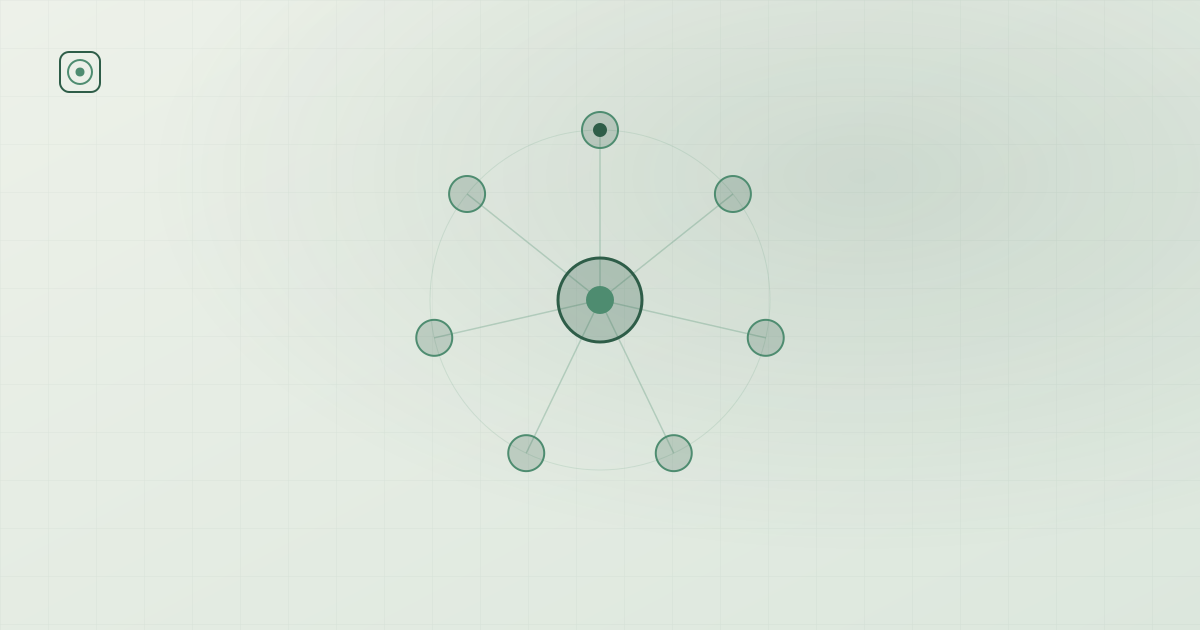
Seven control pillars, ordered roughly the way an agent's lifecycle runs: you cannot govern what you cannot see, and you cannot contain what you cannot stop.
The pillars below are not a maturity ladder to climb one rung at a time. A production agent needs all seven, sized to what it can touch. A read-only research agent and an agent with write access to your payments system sit at very different points: scale the controls to the blast radius, do not apply them uniformly.
1. Inventory and discovery
Maintain a live register of every agent: what it does, which model powers it, which tools and data it can reach, who owns it, and its risk tier. Include agents embedded in SaaS products and built by business units, not only central IT. You cannot govern the agents you do not know exist.
2. Identity and least privilege
Give each agent its own machine identity, distinct from any human. Scope permissions to the specific task, prefer short-lived credentials over standing keys, and remove access the moment it is no longer needed. Broad, permanent tokens are the single largest agent risk multiplier.
3. Guardrails and action boundaries
Define hard limits the agent cannot cross regardless of instruction: allowed tools, value thresholds, rate limits, data it may not touch, actions it may never take. Enforce these outside the model, in the runtime, so a clever prompt cannot argue its way past them.
4. Human oversight and approval gates
Route high-impact actions to a human before execution. Payments over a threshold, external communications, data deletion, and production changes should require an approval that is meaningful, not a rubber-stamp click. Oversight has to be able to actually stop the action.
5. Observability and audit logging
Log every step: the prompt, the plan, each tool call, its inputs and outputs, and the final state change, tied to the agent's identity. Without a full action trail you cannot investigate an incident, prove compliance, or even know what the agent did.
6. Testing and red-teaming
Test across tools and tasks, not just the base model. Probe for prompt injection, tool misuse, permission escalation, and unsafe multi-step paths. Given an 81% hijack success rate in NIST testing, adversarial evaluation is a release gate, not an optional extra.
7. Kill switch and rollback
Build the ability to suspend an agent instantly and to reverse or contain what it did. Revocable credentials, transaction rollback, and a clear off switch matter most exactly when the agent is behaving in a way no one predicted.
The guardian agent pattern. Gartner predicts that "guardian agents," which review, monitor, and where needed block the actions of other agents, will make up 10 to 15% of the agentic AI market by 2030. As agents supervise agents, expect part of pillars 3 through 5 to be enforced by automated overseers rather than by humans watching dashboards.
Mapping the framework to EU AI Act, NIST, and ISO
There is no dedicated "agent law" yet. But agents that make consequential decisions already fall under existing obligations, and the technical standards are catching up fast.
The most common mistake is assuming agents live in a regulatory gap. They do not. An agent screening job applicants or scoring credit is a high-risk AI system under the EU AI Act because of what it decides, not whether it plans its own steps. Autonomy changes how you meet the obligation, not whether it applies.
Operating agent governance day to day
A framework on a slide governs nothing. This is the operating loop that turns the seven pillars into something running in production.
-
Discover every agent, including the ones no one told you aboutRoughly two-thirds of employees already use unapproved AI tools, so assume shadow agents are present before you start looking.
- Scan for agents across sanctioned platforms and network traffic, not just a self-reported list.
- Record each agent's model, connected tools, data access, and trigger conditions.
- Assign a risk tier based on what it can do, from read-only to state-changing.
-
Assign an accountable owner to each agentEvery agent needs a named human owner accountable for its behavior, budget, and decommissioning. Ownerless agents are how privileges outlive their purpose.
- Tie the owner to the agent's identity in the inventory.
- Make the owner sign off on the permission scope and the approval thresholds.
-
Set permission scopes to least privilegeGive each agent its own identity and only the access its task requires, for only as long as it needs it.
- Prefer short-lived, revocable credentials over standing API keys.
- Constrain the tool set and the action limits in the runtime, outside the prompt.
-
Add runtime monitoring and full action loggingWatch agents while they run, not only in pre-production tests. Log every plan, tool call, and state change against the agent's identity.
- Alert on anomalies: unusual tool sequences, volume spikes, access to new data.
- Keep the trail audit-ready so any action can be reconstructed and evidenced.
-
Define escalation and rollback before you need themDecide in advance what triggers a human review, what triggers a pause, and how you undo an agent's actions.
- Route high-impact actions to approval gates that can actually block execution.
- Rehearse the kill switch and the rollback path, the same way you rehearse a disaster recovery drill.
From policy to practice. Spreadsheets and ticket queues rarely keep up with how fast agents spread and act across an enterprise. Dedicated AI governance platforms give governance teams one place to build an agent inventory and agent graph, analyze agentic workflows, and monitor agent behavior at runtime, then evidence it all against frameworks like the EU AI Act, NIST AI RMF, and ISO 42001.
Key Takeaways
- Agents act, chain tool calls, hold credentials, and change state. Governance built to review outputs does not govern actions.
- Agent risk is a layer on top of model risk: autonomy, tool access, non-human identity, memory, multi-agent chains, unpredictability, and speed of harm.
- Most agent damage is self-inflicted. Gartner expects 80%+ of unauthorized agent transactions through 2028 to stem from internal policy violations, not attackers.
- Seven pillars, sized to blast radius: inventory, least-privilege identity, runtime guardrails, human approval gates, full action logging, red-teaming, and a kill switch with rollback.
- Agents in high-risk uses already fall under the EU AI Act. Build controls to the principle (oversight, accountability, traceability) and map one control set to EU AI Act Art. 14, NIST AI RMF, and ISO 42001.
- Operate it as a loop: discover, assign owners, scope permissions, monitor at runtime, and define escalation and rollback before you need them.
Frequently asked questions
Model governance evaluates an output before a human acts on it. Agent governance has to control an action the system takes on its own. That shifts the focus from output quality to what the agent is permitted to do, how it is stopped, and how every action is logged. All model risks still apply to the underlying model; agent governance adds a layer for autonomy, tool access, and state change.
A guardian agent is an AI agent whose job is to oversee other agents: reviewing their output, monitoring their actions, and blocking or adjusting behavior that breaks policy. Gartner expects guardian agents to reach 10 to 15% of the agentic AI market by 2030 as enterprises use automation to supervise automation, since human review does not scale to machine-speed action.
Yes, when their use case is regulated. The EU AI Act classifies systems by risk of use, not by architecture, so an agent used in a high-risk application such as hiring or credit inherits high-risk obligations, including the human oversight requirement in Article 14. Most Annex III high-risk duties apply from 2 December 2027. There is no separate agent exemption.
Least-privilege identity. An agent scoped to exactly the tools and data its task requires, with short-lived credentials, has a small blast radius even when it misbehaves or is hijacked. Broad, standing permissions turn every other failure into a much larger incident, which is why over-permissioning is the biggest risk multiplier.
Test the whole system, not just the base model. Probe for prompt injection through the data and tools the agent reads, attempt tool misuse and permission escalation, and check unsafe multi-step paths across chained actions. NIST and UK AISI testing reached an 81% success rate against agents versus 11% against hardened baselines, so adversarial evaluation belongs at the release gate, then repeated as tools and prompts change.
Discovery. You cannot govern agents you cannot see, and shadow agents arrive through SaaS features and business-unit pilots without central approval. Build a live inventory of every agent with its model, tools, data access, and owner, tier by blast radius, then apply the remaining controls in proportion to each agent's risk.